Resistor types and the color code
15 minutes · Beginner
Simulations and quizzes aren't read aloud; pause when you reach them and try them out.
The resistor is the most used part in electronics. Almost every circuit has dozens of them. In the Electricity Fundamentals course you learned what a resistor does. In this lesson you'll get to know real resistors, tell the types apart and read their values from their markings.
📷 Real-world view
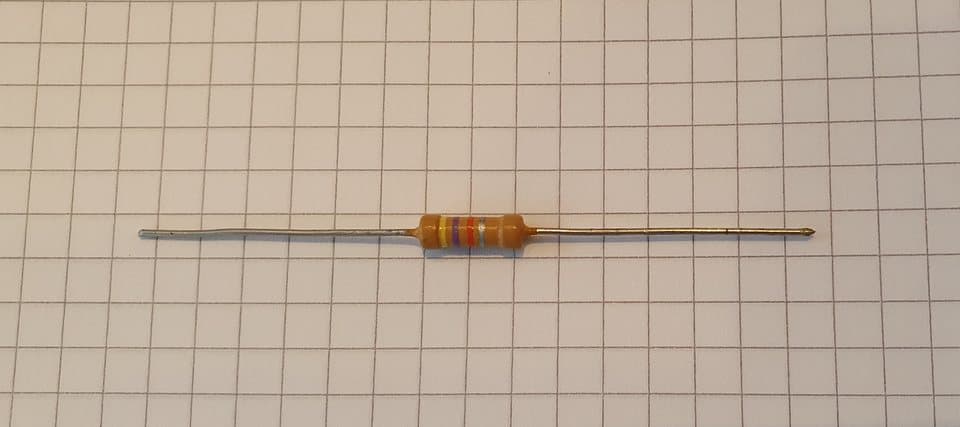
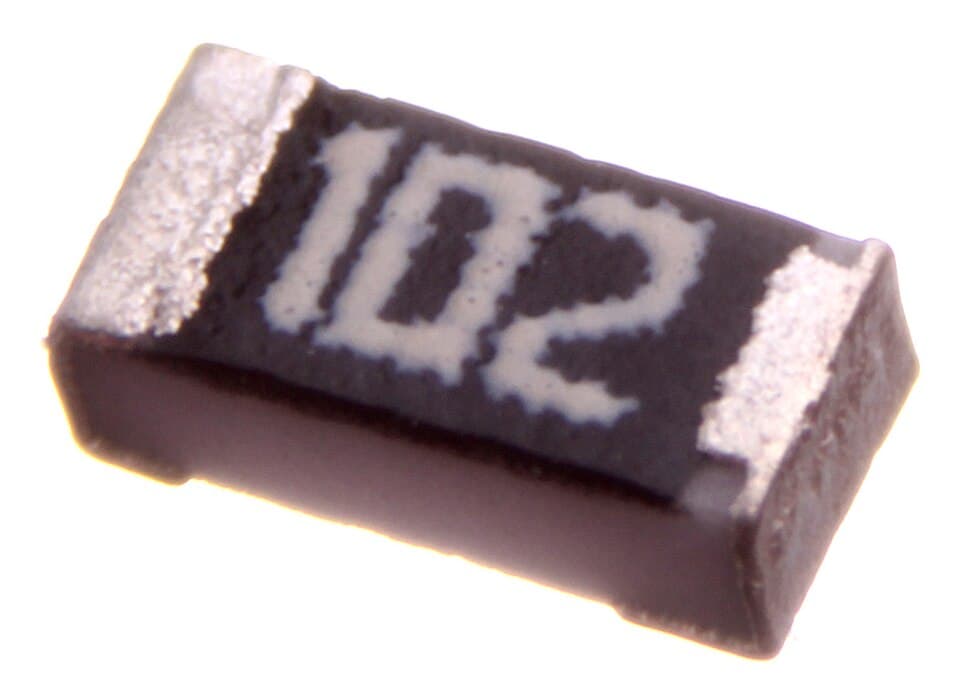
Types of resistor
Carbon film
The cheapest and most common type. Usually a beige body, 4 bands, 5% tolerance. Good enough for most hobby projects.
Metal film
More precise (1%) and less noisy. Usually a blue body with 5 bands. Preferred in measurement and audio circuits.
Wirewound / ceramic
For high power (5 W, 10 W and up). A white rectangular ceramic body with the value printed on it.
SMD (surface mount)
The tiny resistors on phone and computer boards. They have no leads and are soldered onto the board surface. The value is printed as a number code.
What is tolerance?
No resistor can be made at exactly its marked value. Tolerance tells you how far the real value may deviate. A 1 kΩ 5% resistor can be anything between 950 Ω and 1050 Ω. For most circuits this difference doesn't matter.
The 4-band color code
The value of a through-hole resistor is read from the color bands on its body:
- Bands 1 and 2: the first two digits of the value
- Band 3: the multiplier, i.e. the number of zeros to add
- Band 4: the tolerance (gold 5%, silver 10%)
A memory aid
To remember the order of the colors, make up a sentence from their first letters: Black Brown Red Orange Yellow Green Blue Violet Grey White. A sentence you invent yourself sticks best.Try it yourself
4-band color code calculator
Which way round do you read it?
The tolerance band (gold or silver) is usually a little further from the others and should be on the right. Hold the resistor with that band on the right and start reading from the left. If you're not sure, measure it with a multimeter.
5-band resistors
Precision (metal film) resistors have three digit bands, a multiplier and a tolerance band. The logic is the same; only the first three bands are digits. For example brown-black-black-brown-brown = 100 × 10 = 1000 Ω, 1%.
SMD resistor codes
- 103 = 10 × 10³ = 10 kΩ
- 472 = 47 × 10² = 4.7 kΩ
- 4R7 = 4.7 Ω (R marks the decimal point)
- 1002 = 100 × 10² = 10 kΩ (1%)
Standard values: the E12 series
Resistors aren't made in every value. 5% resistors are sold in the values of the E12 series. Each decade contains these 12 values:
10 · 12 · 15 · 18 · 22 · 27 · 33 · 39 · 47 · 56 · 68 · 82
So you'll find 100 Ω, 120 Ω, 150 Ω... or 1 kΩ, 1.2 kΩ, 1.5 kΩ..., but not 200 Ω or 5 kΩ. You pick the standard value closest to the one your calculation gives.
Question: You calculated 360 Ω for an LED. Which resistor should you use?
The nearest E12 values to 360 are 330 Ω and 390 Ω
To keep the LED current on the safe side, choose the larger one: 390 Ω
When in doubt with current-limiting resistors, always pick the larger value. The current drops a little and the LED is slightly dimmer, but it isn't damaged.
Common mistakes
- Reading the resistor from the wrong end. The tolerance band should be on the right.
- Mixing up brown and red, or orange and red, in dim light. When in doubt, measure with a multimeter.
- Forgetting the power rating. A small resistor with the right ohm value burns out at high current.
Test yourself
1. What is the value of a yellow-violet-red-gold resistor?
2. What is the value of a brown-black-orange-gold resistor?
3. What is the value of an SMD resistor marked 221?
4. What range is the real value of a 100 Ω 5% resistor in?
This was the free first lesson of the course
The remaining 7 lessons of Basic Electronic Components, with their simulations and quizzes, unlock when you buy the course.
See the full course →